
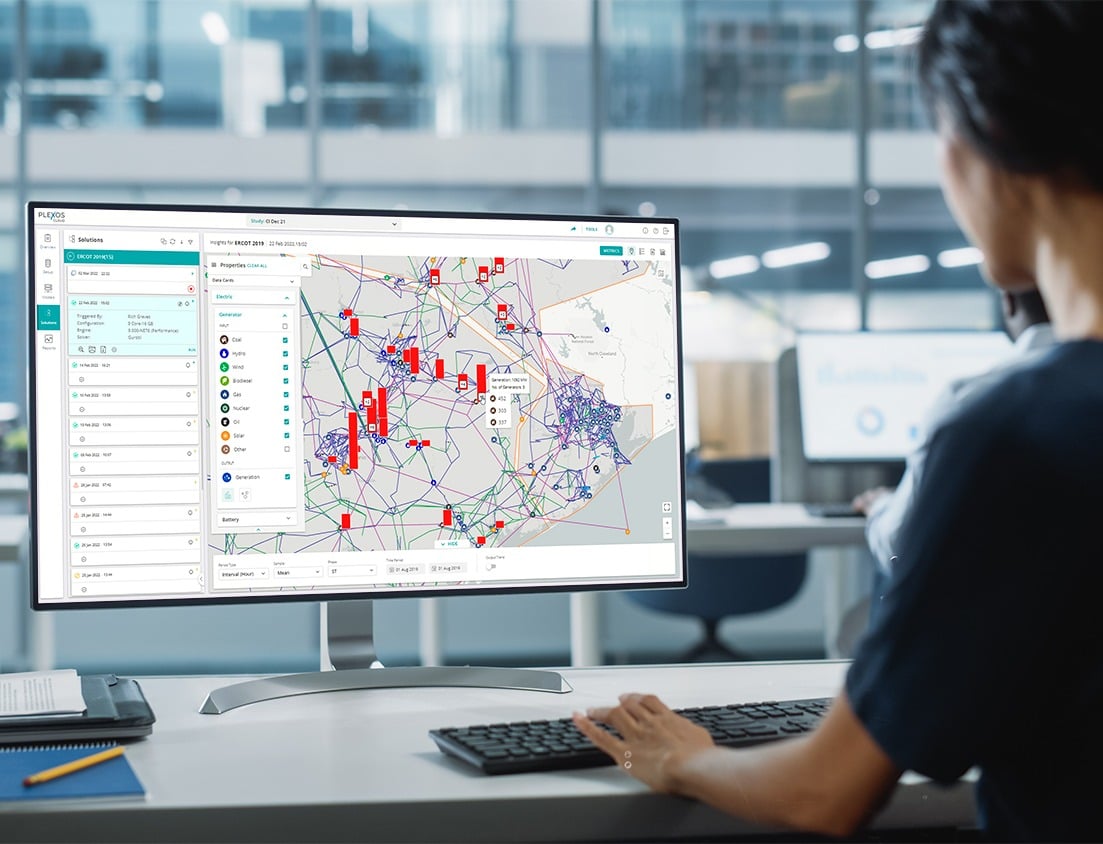
Context & Problem
PLEXOS is used by energy companies, regulators, and consultancies worldwide to model electricity markets, forecast prices, evaluate capital investments, and run risk assessments. The desktop application is extremely powerful, but that power came with significant usability friction.
As the product moved to the cloud, the challenge went beyond re-platforming. The existing workflows assumed a single-user, local-machine context. Cloud meant multi-user collaboration, shared datasets, role-based access, and the ability to spin up thousands of compute cores for stochastic simulations. The interface needed to handle all of this complexity without overwhelming users who were energy analysts first and software users second.
Key problems included: simulation setup required deep technical knowledge with no guided paths, results were buried in raw data exports with limited contextual visualization, collaboration meant emailing files back and forth, and there was no governance model for shared datasets or simulation configurations.
My Role & Scope
I served as the senior product designer for the PLEXOS Cloud experience, working alongside the product director, engineering leads, domain experts, and customer-facing teams. My scope covered the full cloud platform UX, from onboarding and dataset management to simulation workflows, results dashboards, and team collaboration features.
Constraints & Stakeholders
- Domain complexity: Energy modeling involves highly specialized concepts (stochastic analysis, nodal pricing, capacity planning). Simplifying the UI couldn't mean dumbing down the capabilities. Expert users needed full control; less technical stakeholders needed clear summaries.
- Parity expectations: Long-time desktop users expected cloud to match or exceed existing functionality. Any perceived regression would block adoption.
- Multi-persona workflows: Analysts building models, managers reviewing results, executives making investment decisions, and IT teams governing access, all with different mental models and different tolerance for complexity.
- API-first architecture: The platform exposed a RESTful API for integrations. The UI needed to surface API capabilities in a way that felt native, not like a wrapper around endpoints.
Process & Key Decisions
1. Workflow mapping before wireframes
I spent the first phase mapping actual user workflows, not just the happy paths, but the workarounds, the Excel-based side processes, the email chains for approvals. This exposed the real friction: it wasn't that the tool was hard to use; it was that the tool only covered part of the workflow. Everything around it was manual.
2. Progressive disclosure for complex data
The core design principle became progressive disclosure. Simulation setup was restructured into guided stages with sensible defaults that expert users could override. Results dashboards showed headline metrics first, with drill-down paths to raw data. This let analysts go deep when needed while giving executives a clear summary without requiring a modeler to interpret it for them.
3. Collaboration as a first-class feature
On desktop, "collaboration" meant shared network drives. For cloud, I designed a workspace model with shared datasets, simulation configurations, and results, all with role-based permissions. Team members could see who ran what, review configurations before execution, and annotate results with context that would otherwise live in email threads.
4. Stochastic results visualization
A single stochastic analysis could produce hundreds of simulation runs. The existing approach dumped everything into downloadable CSV files. I designed a dashboard that summarized distributions, highlighted outliers, and let users compare scenarios visually, turning hours of spreadsheet work into minutes of interactive exploration.
5. Scalable compute, transparent cost
Cloud meant elastic compute, and users could spin up thousands of cores for large studies. But "unlimited compute" without visibility creates anxiety and cost overruns. I designed a resource monitor that showed compute allocation in real time, estimated completion times, and projected costs before execution, giving users confidence to scale without fear.
6. AI-powered design iteration
Leveraged AI-powered design tools to rapidly iterate on complex interface concepts, generating and evaluating multiple layout directions for data-dense screens in a fraction of the time traditional methods would require. This accelerated the exploration phase significantly, allowing the team to converge on stronger solutions faster while preserving time for the high-judgment decisions that demanded human craft.
What Changed
Simulation setup time reduced from hours of manual configuration to a guided workflow with intelligent defaults
True multi-user collaboration replaced file-based sharing. Teams could work on shared datasets with role-based governance
Stochastic dashboards turned hundreds of simulation runs into visual, explorable summaries accessible to non-technical stakeholders
Resource monitoring gave teams cost visibility and confidence to leverage elastic cloud compute at scale
Outcome & Impact
The redesigned cloud experience fundamentally changed how teams interacted with the platform:
- Broader adoption within organizations: Features like role-based dashboards and guided workflows opened the platform to stakeholders who previously relied on analysts to interpret results, expanding the user base beyond the traditional modeler persona.
- Faster analysis cycles: Studies that previously took days of desktop processing ran in minutes on cloud infrastructure, and results were immediately shareable, compressing decision timelines for capital investment evaluations and regulatory filings.
- Reduced support burden: Contextual guidance, progressive disclosure, and inline documentation reduced the learning curve and decreased dependency on customer success for basic workflow questions.
- Enterprise-ready positioning: Governance features, audit trails, and role-based access made the platform viable for large organizations with strict compliance requirements, opening new market segments.
Lessons Learned
Complexity is not the enemy, confusion is
Expert tools should stay powerful. The design challenge isn't removing complexity but organizing it so users encounter the right level of detail at the right moment. Progressive disclosure isn't about hiding things; it's about sequencing them.
Cloud is not just re-platforming
Moving to cloud isn't a deployment decision; it's a product decision. Multi-user, collaborative, always-on changes the fundamental interaction model. The UX has to be reimagined, not just responsive-ified.
Design for the workflow, not the screen
The biggest wins came from designing end-to-end workflows, including the parts that happened outside the tool. When we brought email-based approvals and spreadsheet-based analysis into the platform, that's when users felt the real value of cloud.